Photovoltaics & green roof
Green roof with a PV system — your roof can do twice as much.
We combine extensive roof greening with commercial photovoltaics on a single surface. This cools your modules, retains rainwater and protects the waterproofing. You increase yield and benefit from a roof that lasts longer.
Why combine
Two systems, one roof — green roof and photovoltaics.
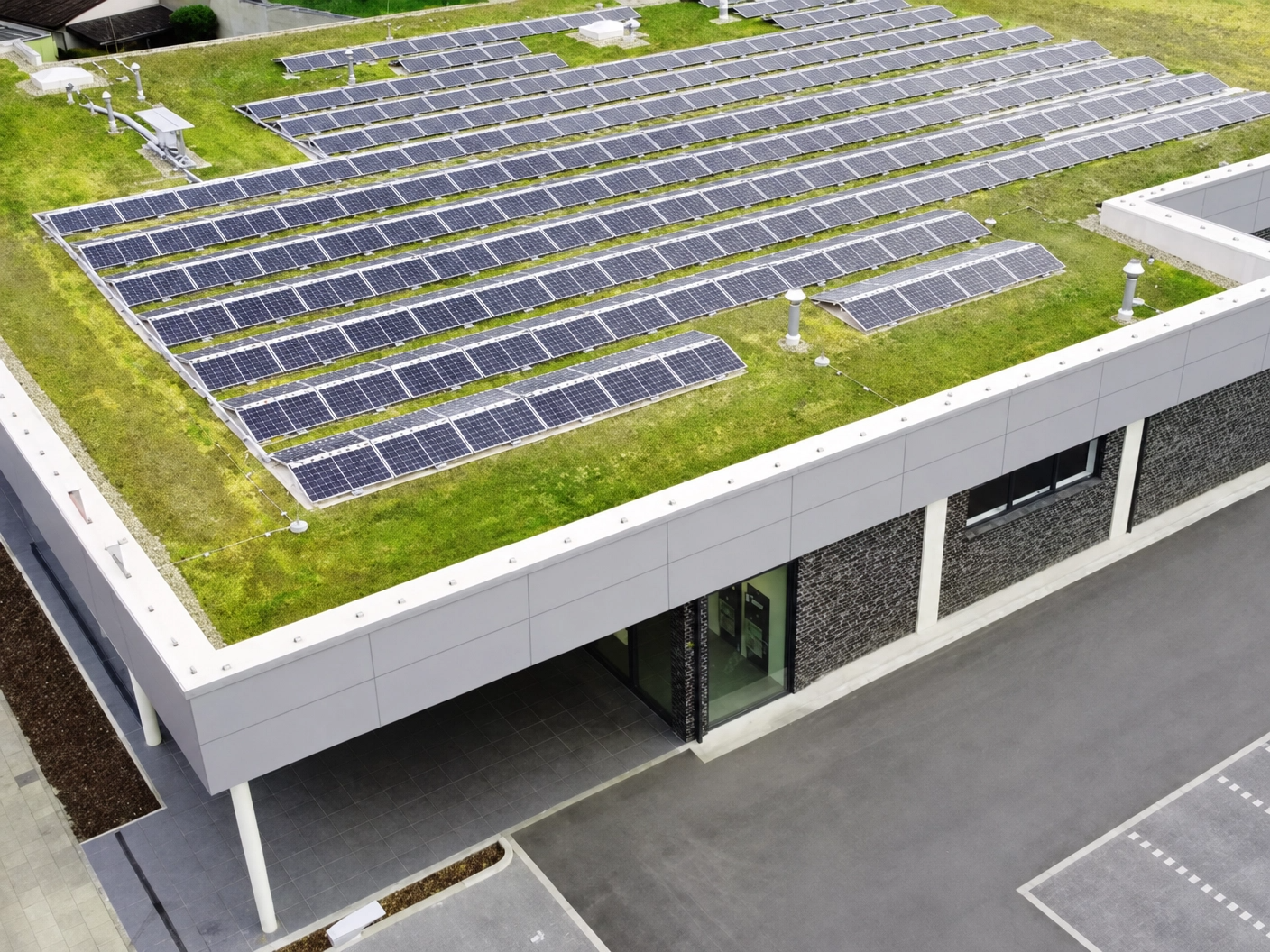
For a long time it was one or the other: green roof or photovoltaics. Today we realise both on the same surface. The planting layer weighs down the ballasted mounting structure. The photovoltaic modules are then mounted on the substructure designed for this, which is suitable for a green roof.
The result is a roof that simultaneously generates electricity, cools the building, buffers rainwater and creates habitat. We plan, build and operate the system during ongoing operation. Our top priority is that your operations are not disrupted.

Yield
Cooler modules, more yield
The evaporation from the green roof lowers the temperature around the modules on hot days. Because photovoltaics lose performance in heat, you gain several percent of additional yield year after year thanks to the cooler roof surface.
Climate & water
Retain rainwater, relieve the town
The green roof stores a large part of the precipitation and releases it with a delay. This relieves the sewer system, in many places lowers the rainwater charge and creates habitat for insects and birds right in the middle of the industrial area.


Protection
Protects the waterproofing, extends the service life
The vegetation layer shields the roof waterproofing from UV radiation and temperature peaks. Our ballasted mounting largely avoids roof penetrations. This means there are no interventions in the roof membrane, which has a positive effect on the roof's service life.
Funding & ESG
Fundable and ESG-effective green roofs
Many development plans require roof greening anyway. Combined with a PV system, you meet the requirement and use the surface twice over. Both count measurably towards your sustainability record. We provide advice here and point out relevant funding options.

Layer structure
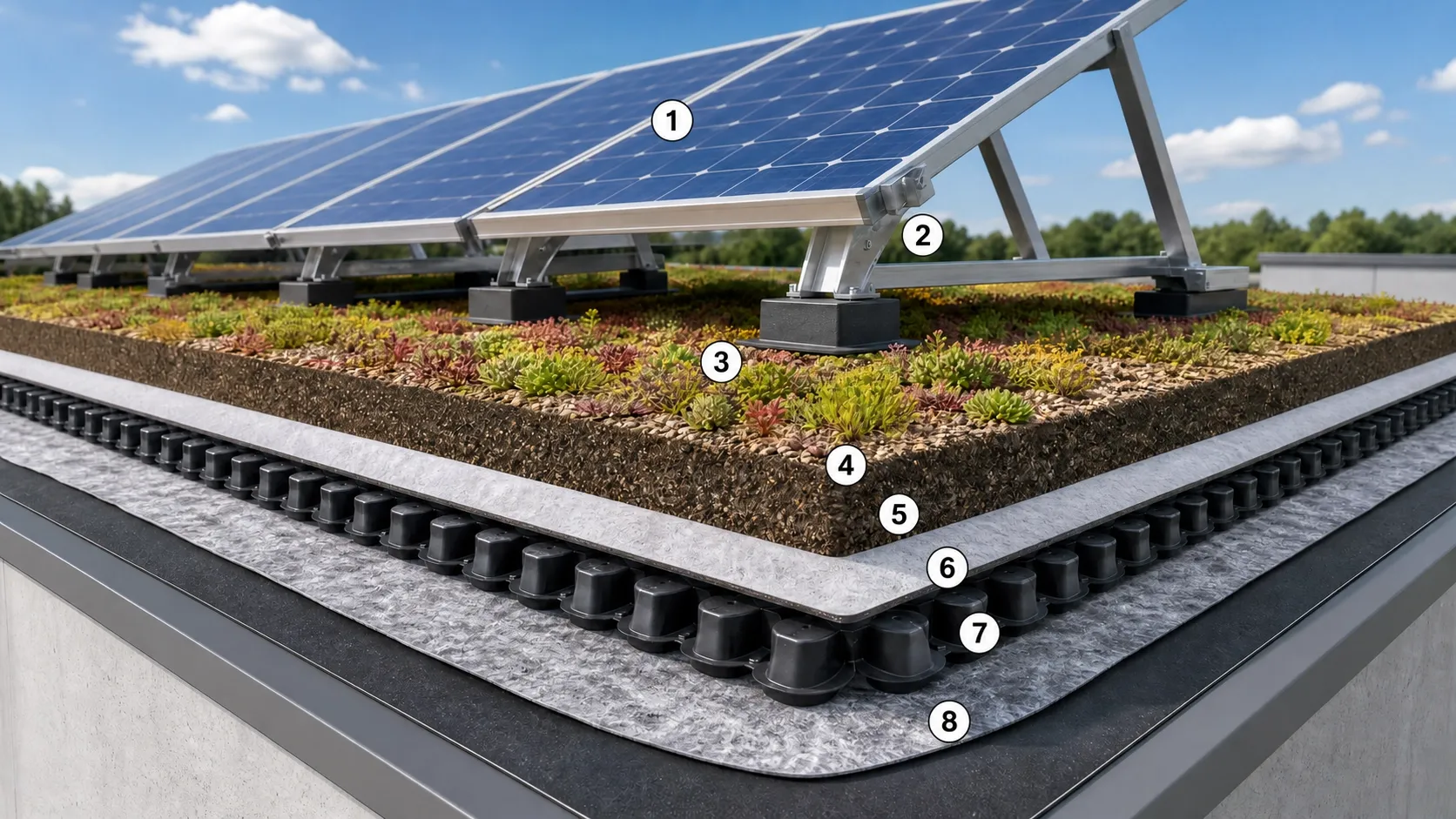
How a green roof with a PV system is built up
Begrünung und Photovoltaik bilden ein integriertes System: Schutz-, Speichervlies sowie das Dränageelement samt Filtervlies tragen Substrat und Aufständerung und kommen so möglichst ohne Dachdurchdringung aus.
Frequently asked questions about green roofs and photovoltaics
The most important answers on greening obligations, the solar green roof and cost-effectiveness — summarised concisely.
Gibt es in Deutschland eine Begrünungspflicht für Dächer?
There is no nationwide obligation. The requirements arise from the state building regulations and municipal statutes. However, more and more towns and cities are prescribing roof greening for new builds. This is the case particularly for flat roofs above a certain size.
In welchen Städten gilt bereits eine Begrünungspflicht – und ab welcher Dachgröße?
Several major cities already require developers to green roofs on new builds today. The thresholds differ from city to city:
- Berlin: new builds from 100 m² of roof area and up to 10° roof pitch (at least 60% greened)
- Frankfurt am Main: new builds from 500 m² (at least 50%)
- Hamburg: new builds from 200 m²
- Cologne: new builds from 500 m² (at least 50%)
- Leipzig: new builds with low-pitched roofs, also for alterations to existing buildings
- Munich: new builds from 250 m²
- Stuttgart: new builds from 150 m²
The respective current municipal statute is decisive; the exact requirements should be checked on a case-by-case basis with the responsible building authority.
Was bedeutet die geplante Solargründach-Pflicht ab 2027?
From 2027, Hamburg plans a more far-reaching rule: for new builds and roof renovations, around 70% of the roof area should be greened and 30% covered with photovoltaics. Whether other cities and federal states will follow suit remains open — but the combination of greening and photovoltaics is clearly gaining importance.
Lassen sich Photovoltaik und Dachbegrünung kombinieren?
Yes. With what is known as the solar green roof, the two systems complement each other: the greening cools the roof, which increases the PV system's yield by about 4 to 6%. The roof surface is thus used three times over — for electricity generation, weather protection and climate protection.
Welche Vorteile bietet ein Gründach mit PV für Unternehmen?
Green roofs store rainwater and relieve the sewer system during heavy rain, lower temperatures on the roof, extend the service life of the roof waterproofing and improve the indoor climate. In combination with photovoltaics, a higher solar yield is added.
Welche Förderungen gibt es für Gründächer?
At federal level, the KfW supports with low-interest loans and grants. Many municipalities provide additional funding — for example with grants per square metre of greening or with reduced rainwater charges. The specific programmes vary by location.
Ready to use your roof as a green roof with a PV system?
Share the key details about your site with us. We'll get back to you with a first assessment of a holistic energy solution for your company.
Get in touch